
Full-Stack Software Developers: Industry Reality or Modern Tech Myth?
In the software industry, the term "Full-Stack Developer" is one of the most debated titles. To some, it’s the ultimate badge of a versatile engineer; to others, it’s an impossible standard that no single human can truly master.
If you are looking to understand the mechanics of modern web development - specifically within the PHP and Laravel ecosystem - it’s time to move past the buzzwords and look at the actual architecture.
Defining the Layers: The PHP Laravel Stack
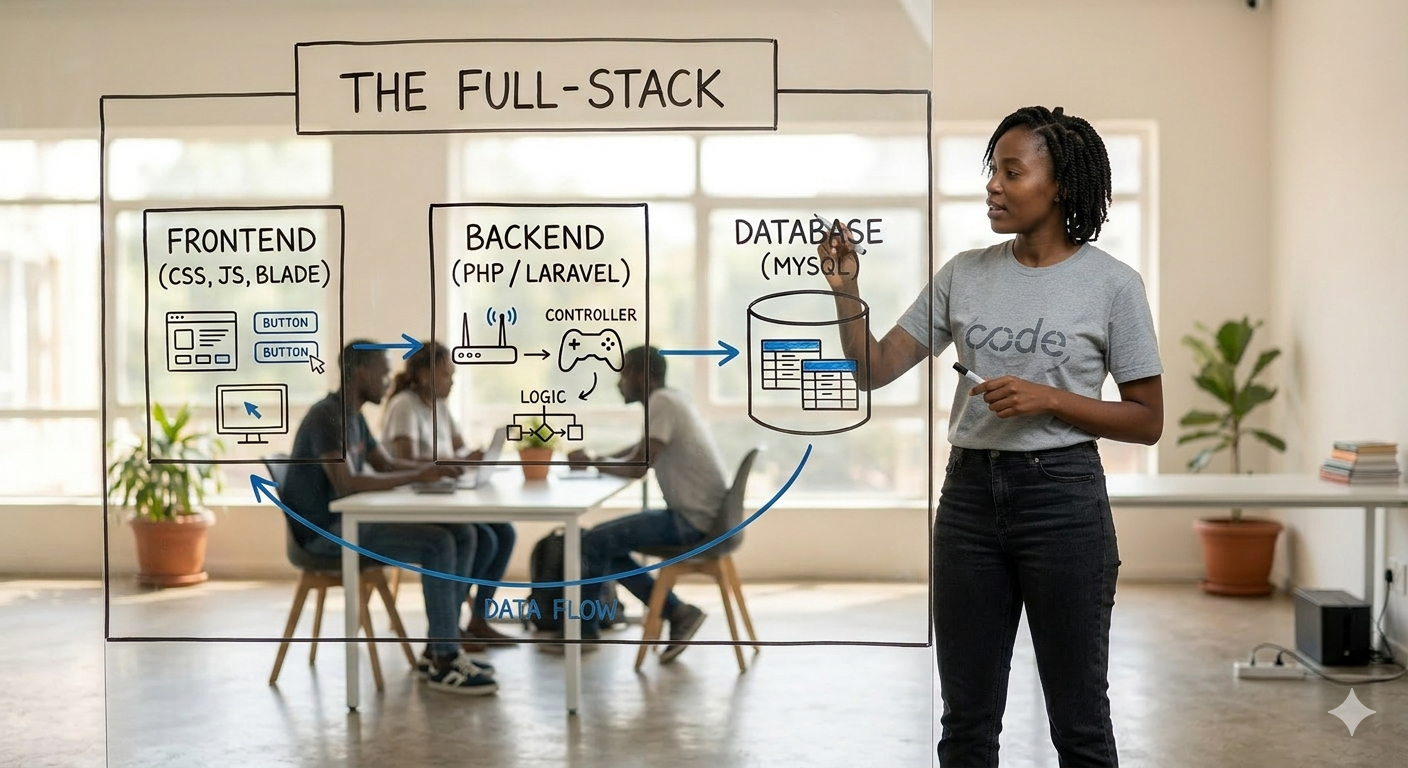
A full-stack developer is an engineer capable of navigating every layer of an application’s architecture. To understand this, let’s look at a typical Laravel setup:
1. The Frontend (The Presentation Layer)
This is the interface the user interacts with. A professional full-stack developer doesn't just "make things pretty." They use HTML for structure and Pure CSS for high-precision styling. They ensure the site is responsive across all devices and often use JavaScript to handle real-time updates without refreshing the page.
2. The Backend (The Logic Layer)
This is where the "heavy lifting" happens. Using PHP, the developer writes the business logic. Laravel acts as the engine here, providing a structured way to handle security, user authentication, and communication with other services.
3. The Database (The Persistence Layer)
Applications need to "remember" things - like user profiles or transaction histories. A full-stack developer designs the database schema (usually in MySQL) and writes optimized queries to ensure data is retrieved quickly and securely.
The Big Debate: Is "Full-Stack" Actually a Myth?
There is a common argument that "Full-Stack" is a concept rather than a reality. The logic is that because technology evolves so fast, one can only be a "Master" of one side and a "Student" of the other.
The Reality: Full-stack developers definitely exist, but they are Generalists, not "Omniscient Experts."
A true full-stack developer is someone who understands the Data Flow. They know how a click on a button (Frontend) triggers a route in the code (Backend), which then updates a row in a table (Database). They might have a "lead" side where they are stronger, but they are competent enough to build and deploy a functional, professional-grade product from scratch without needing a team.
What It Takes (And How Many Years)
You cannot "bootcamp" your way into being a seasoned full-stack developer. It requires a deep understanding of different mental models - switching from the visual logic of CSS to the mathematical logic of a MySQL query.
The Realistic Timeline
While everyone learns at a different pace, the industry generally recognizes these stages:
-
Years 1–2 (Foundation): You are usually learning the syntax. You can build features, but you often struggle when things break outside of your comfort zone.
-
Years 3–4 (Competency): This is where you become a "True" Full-Stack developer. You start thinking about Software Architecture - how to build systems that are easy to maintain and scale.
-
Years 5+ (Seniority): At this stage, you aren't just a coder; you are a problem solver. You can look at a business requirement and immediately see the full map of the frontend, backend, and database needed to make it happen.
Verdict: It takes approximately 4 to 6 years of consistent, professional experience to truly claim the "Full-Stack" title with confidence.
Conclusion: Why It Matters
In a fast-growing tech landscape, the Full-Stack Developer is the bridge between a business idea and a live product. While they might not be the world's leading expert in every single sub-library, their value lies in their ability to see the whole picture and execute it.
Whether you are using a robust framework like Laravel or building custom tools with Pure CSS, the goal remains the same: creating a seamless experience for the user by mastering the world behind the screen.