
The Coding Trap: Why Your Health is Just as Important as Your Code
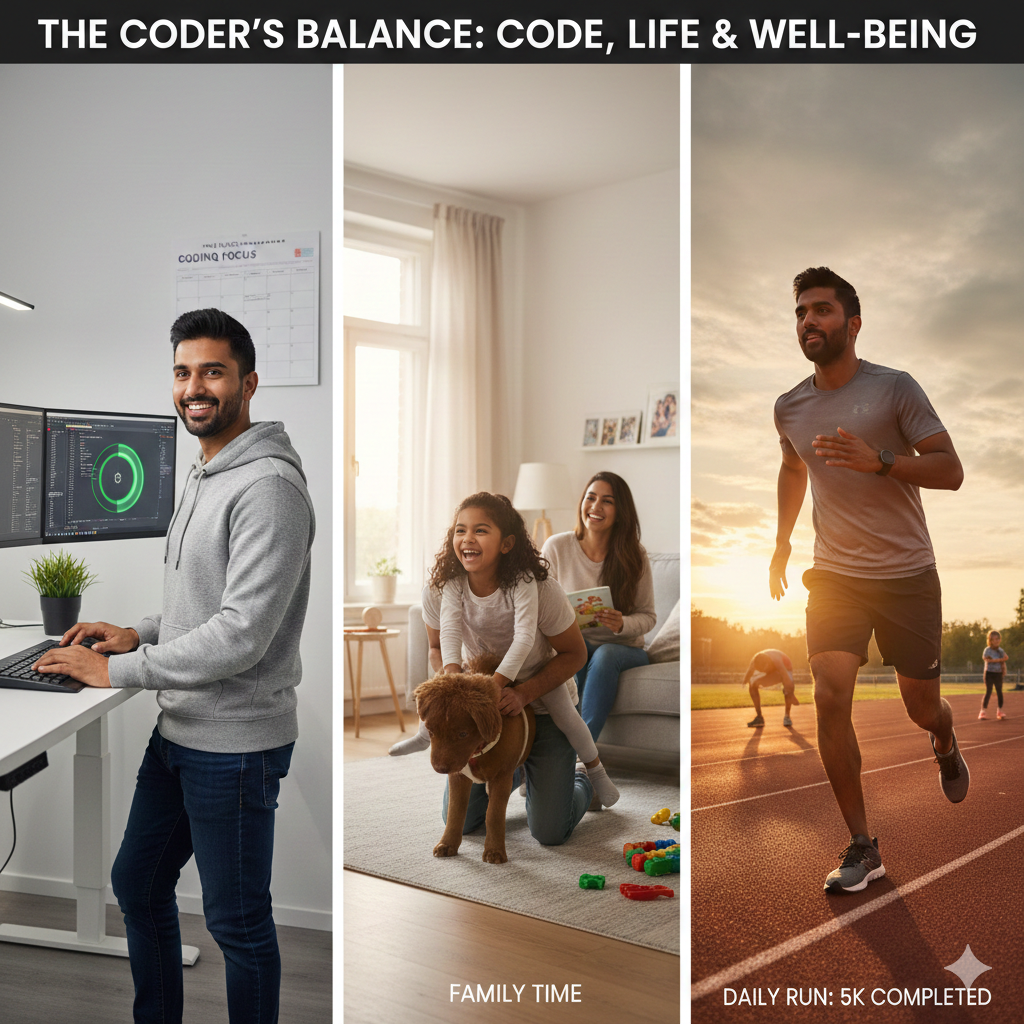
Let’s be honest: being a software developer is cool, but it’s also exhausting.
If you are a dev, you know the feeling. You sit down at 9:00 AM, you start solving one "tiny" bug, and suddenly you look up and it’s 8:00 PM. Your back hurts, your eyes are blurry, and you’ve missed dinner with your family. Again.
We love building things. We love the feeling of finally getting a complex piece of logic to work. But there is a dark side to this job that we don't talk about enough: the sitting, the stress, and the isolation. In this article, I want to talk about why we get stuck in this trap and, more importantly, how we can break out of it.
Why is it so hard to step away?
Before we look at solutions, we have to understand the problem. Why do we find it so "impossible" to strike a balance?
1. The "Just One More Line" Syndrome
Coding is addictive. Unlike many jobs, our work provides instant feedback. When you fix a bug, you get a hit of dopamine. This keeps you glued to the chair. You tell yourself, "I’ll stop after I finish this function," but that function leads to another one, and before you know it, you’ve been sitting for five hours straight.
2. The Pressure of the Deadline
In the world of tech, everything is "urgent." Clients want things yesterday. Managers push for shorter sprints. When you have a tight deadline, the first things you sacrifice are the things that don't have a "ticket" attached to them—like your sleep, your gym time, and your time with your kids.
3. The Physical Cost of Sitting
Our bodies weren't made to sit for 10 hours a day. When we sit too much, our metabolism slows down, our posture ruins our necks, and we feel sluggish. This creates a cycle: you feel tired, so you drink more coffee, which makes it harder to sleep, which makes you less productive the next day.
The "Impossible" Balance: How to Reclaim Your Life
You might think that to be a "great" developer, you have to work 80 hours a week. That is a lie. A tired developer makes mistakes. A stressed developer writes "spaghetti code." To be a high-performing professional, you actually need to be healthy.
Here are some simple, real-world ways to start finding that balance.
1. Set "Hard" Boundaries
If you work from home, the line between "home" and "work" disappears. You need to draw that line back in.
- The "Closed Laptop" Rule: Pick a time—let’s say 6:00 PM—where the laptop goes in a drawer or stays in another room.
- Notifications: Turn off work emails and Slack on your phone after hours. If the server isn't literally on fire, it can wait until morning.
2. Move Every Single Hour
You don’t need to run a marathon every day to be healthy. You just need to stop being a statue.
- The 50/10 Rule: Work for 50 minutes, then stand up and walk for 10. Go get water, stretch your back, or just look out the window to give your eyes a break.
- Standing Desks: If you can, get a desk that goes up and down. Changing your position even twice a day makes a huge difference for your back.
3. Family Time is a "Project" Too
We are great at managing projects at work, but we often forget to manage our personal lives.
- Schedule it: If you have to, put "Dinner with Family" or "Play with Kids" on your actual calendar. If it’s on the calendar, you are more likely to respect it.
- Be Present: When you are with your family, be there. Don't think about the database schema while your spouse is talking to you. The code will still be there tomorrow, but these moments won't.
4. Sleep is a Productivity Tool
Many devs wear "sleepless nights" like a badge of honor. It’s actually a sign of bad planning.
- Lack of sleep kills your logic and creativity.
- If you get 8 hours of sleep, you might solve in 2 hours what would have taken you 5 hours if you were tired. Sleep isn't "lazy"—it's a performance enhancer.
5. Find a "Low-Tech" Hobby
Since we spend all day in a digital world, your brain needs a break from screens.
- Try something manual: cooking, gardening, weightlifting, or even just walking the dog.
- Doing something with your hands that doesn't involve a keyboard helps reset your brain and prevents burnout.
A Final Word: You Are Not Your Code
The truth is, your job is just one part of your life.
If you disappeared tomorrow, your company would post a job opening for your position within a week. But your family? Your friends? Your own body? Those are things you can't just "replace" or "refactor."
Striking a balance isn't a one-time thing; it’s a daily choice. You have to decide that your health and your relationships are just as important as the software you build. Start small. Stand up more. Close the laptop. Go outside.
Your code will be better for it, and more importantly, you will be better for it.